
Reviewed · WALKING TOURS
Private Prague Art Nouveau and Cubism Walking Tour
Prague’s old center is famous for Gothic towers and Renaissance façades, but this private Art Nouveau and Cubist walk shows what happened when the city looked toward modern Europe. You’ll read buildings through their lamps, lettering, leaves, mosaics, interiors, and odd angles rather than simply ticking off monuments.
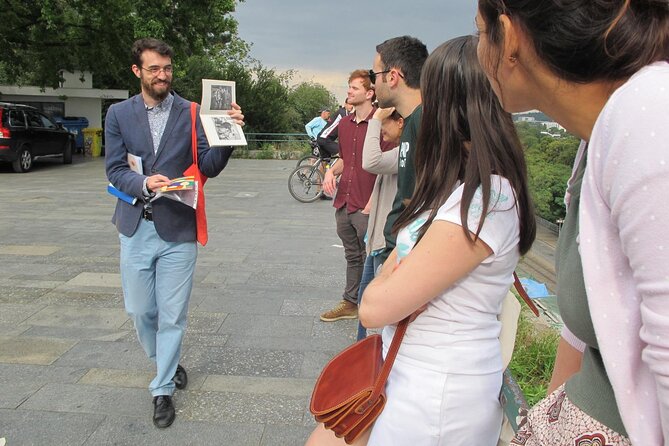
I like the personal scale: your group alone gets a historian’s attention, and the route links design with Czech politics and national identity. I also like the unusual stops, especially the Czechoslovak Legion Bank and the upside-down statue of King Wenceslas. The drawback is simple: three hours means a lot of walking, and the tour is not a good match for anyone with limited mobility.
Key points at a glance
- Private group of up to 10: You get a focused walk rather than a large, stop-and-start group.
- Nine sharply different stops: The route covers Cubist façades, Art Nouveau interiors, a railway station dome, an arcade, and a modern sculpture.
- History behind the decoration: Your guide connects flowers, typography, buildings, and public art with Czech optimism and national identity.
- Two notable guides: Robert Wesley brings a personal Czech-Nigerian background to the walk, while Bonita combines art, architecture, culture, and history.
- A three-hour city walk: The pace gives you time for explanation, but you should wear comfortable shoes and expect steady movement.
- Good value for a group: At $396.46 for up to 10 people, the per-person cost drops sharply when shared by a family or small party.
Why Prague’s modern side is worth your morning
The most useful thing about this tour is its time period. Prague can pull you backward for days, from Gothic churches to Baroque churches and medieval lanes. This walk moves into the years around the turn of the 20th century, when new art, new materials, new public buildings, and a stronger Czech identity were changing the city.
Art Nouveau is not just a matter of pretty curves. Your guide points out details such as ornate light fixtures, flowing type on signs, and gingko biloba leaves on façades. Those leaves hint at the style’s interest in forms from outside Europe, while the posters and magazines of the period help explain why lettering became part of a building’s visual design.
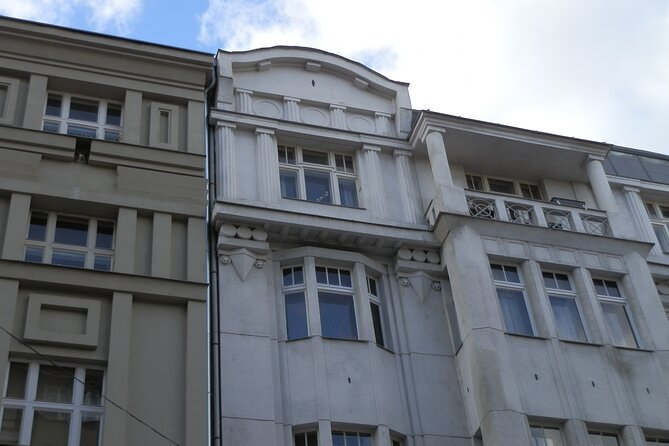
Cubism gives you a different lesson. Instead of soft lines and plant shapes, you see sharp planes, geometric forms, and architecture that seems to break itself into pieces. Prague is especially rewarding for this because Cubism appears not only in paintings, but also in buildings and interiors.
I find that pairing these styles makes the walk easier to understand. You are not asked to memorize dates and names in isolation. You can compare one building’s curves with another building’s angles, then ask what each style says about the people and the era that made it.
More Walking Tours in Prague:
- Prague: 3-Hour Walking Tour of Old Town & Prague Castle
★ 4.7 · 5,696 reviews - Prague: Ghost Walking Tour Where Legends Come To Life
★ 4.4 · 5,253 reviews - Prague: Jewish Quarter Walking Tour with Admission Tickets
★ 4.7 · 3,729 reviews
Starting at the House of the Black Madonna
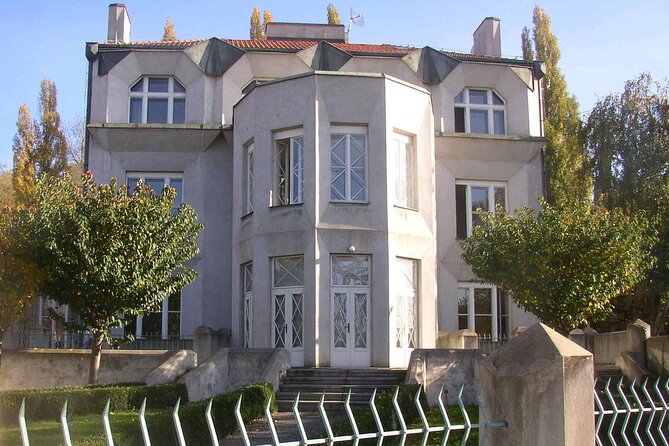
The route begins at the House of the Black Madonna, one of Prague’s best-known Cubist buildings. The stop is brief, about 10 minutes, but it sets the visual rules for the rest of the walk.
Look for the building’s hard-edged geometry and unusual shape. This is a good place to ask your guide how Cubist ideas work when they are moved from a canvas into a city street. The appeal is not only the façade. The building helps you see that Prague’s modern design history was not imported as a complete package. Czech architects adapted new European ideas in their own way.
Because admission is free and the stop is short, you will likely spend most of the time looking and listening from the street. If you want a long interior visit, this tour is not designed for that. It is a guided city walk with selected views, not a museum program.
Obecní Dum and Prague’s Art Nouveau confidence
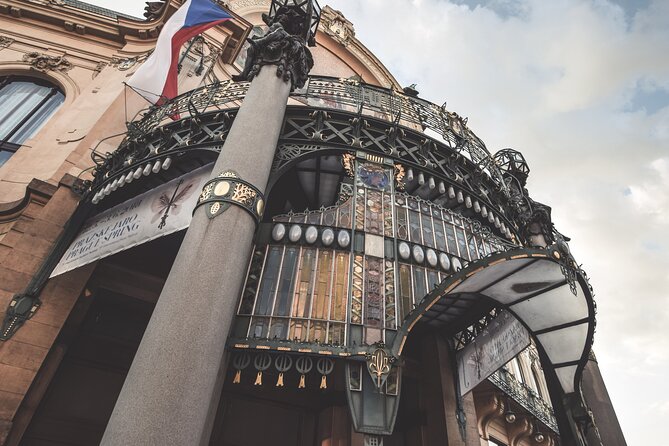
Obecní Dum, or the Municipal House, receives about 15 minutes. It is one of the strongest Art Nouveau stops in the city, and it gives the tour a grand public face.
Here, decoration is part of the message. Art Nouveau curves, ornament, and crafted detail show how a major civic building could present Czech culture as modern, confident, and ready to participate in wider European trends. Your guide can help you separate the surface beauty from the larger idea: this was a time when design could announce national ambition.
This is one of the points where a private guide matters. In a group of 30 people, you might hear a few facts and move on. With your own guide, you can pause over a feature that catches your eye and ask how it relates to the period’s politics, art, or daily life.
K+K Hotel Central and Café Imperial
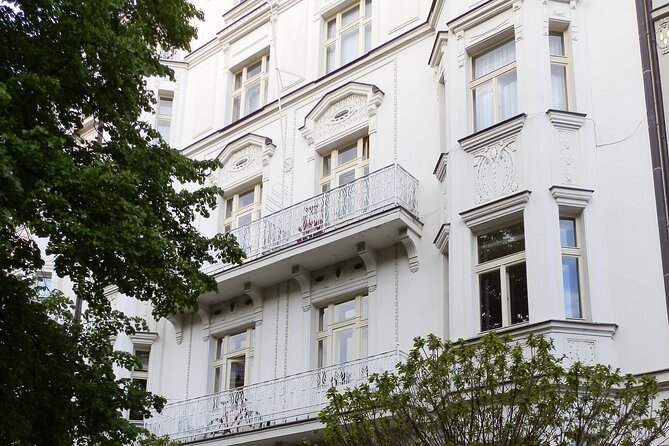
The K+K Hotel Central Prague is described as Prague’s first Art Nouveau building, and the stop lasts about 10 minutes. It offers a useful contrast with Obecní Dum. Instead of seeing only a ceremonial civic structure, you are looking at a building connected to urban life, lodging, and the city’s growing modern identity.
The tour then moves to Café Imperial for about five minutes. Its Art Nouveau interior gives you a quick look at how the style reached inside a building. Walls, furnishings, lighting, and decorative patterns could all work together, turning an ordinary public room into a carefully designed setting.
The short time at Café Imperial is both a benefit and a limitation. You get a taste of the interior without using much of the route, but you should not expect an extended café visit or time for food. Food and drinks are not included, so treat this as an architectural stop rather than a meal break.
A few more Prague half-days to weigh up
- Prague: 50-Minute Sightseeing Evening Cruise
★ 4.2 · 33,780 reviews - Prague: Medieval Dinner with Unlimited Drinks
★ 4.4 · 19,847 reviews - Prague: Skip-the-line Castle Ticket and Optional AudioGuide
★ 4.3 · 11,121 reviews - Prague: Castle Tour with Local Guide and Entry Ticket
★ 4.6 · 10,422 reviews
The Czechoslovak Legion Bank’s sharp angles
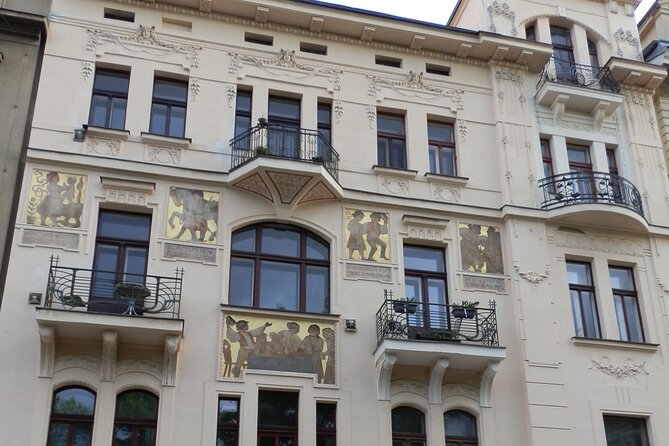
The Czechoslovak Legion Bank takes roughly 10 minutes and brings Cubism back into focus. Its architecture and interior are dedicated to the Czechoslovak Legion of the First World War, giving the stop a strong link to national memory.
This is one of the more distinctive places on the route because the design is tied to a specific Czech institution and historical cause. Your guide can explain how a building’s style and purpose work together. The geometric forms are not merely an abstract design exercise. They sit within a story about war, citizenship, and the creation of a modern Czechoslovak identity.
For me, this is the sort of stop that gives the walk its value. A photo can show you a façade, but it cannot explain why a bank dedicated its design to the Legion or how that choice fit the country’s sense of itself.
Prague Main Station’s Art Nouveau dome
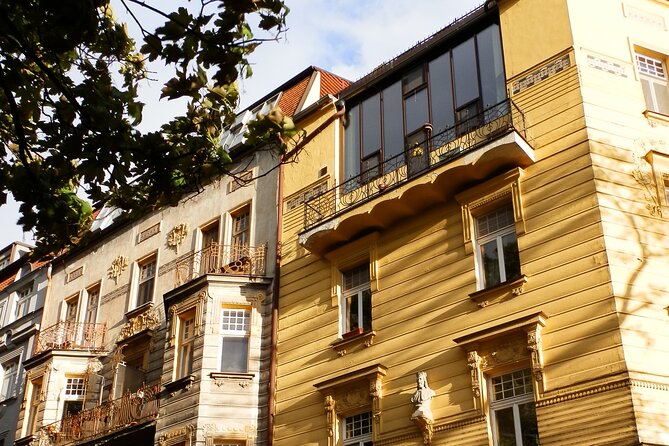
Prague’s main railway station is not usually the first place people associate with architecture, which is exactly why it works well here. The stop lasts about 15 minutes and focuses on the station’s magnificent Art Nouveau dome and interior.
Railway stations were symbols of movement and modern life. They connected cities, carried new ideas, and made travel more central to everyday life. In that setting, an ornate dome could do more than decorate a waiting area. It could tell arriving passengers that Prague belonged to the modern age.
You will also appreciate the change of mood. After the crisp geometry of Cubist buildings, the station returns you to curves, ornament, and decorative flow. The route keeps asking you to compare rather than simply admire.
Wenceslas Square and the Lucerna Arcade
Wenceslas Square gets about 15 minutes, with discussion of its Art Nouveau and Art Deco architecture. The square is one of the route’s larger urban settings, so it helps you see how modern styles shaped a whole public space rather than a single building.
This is a good point to connect architecture with everyday city life. Hotels, shops, public buildings, and signs all helped create the look of a new Prague. Your guide can point out how the square reflects the shift from Art Nouveau’s flowing ornament toward Art Deco’s cleaner, more restrained forms.
The route then enters Lucerna Arcade for about 10 minutes. Its Art Nouveau interior is among the most attractive arcade spaces in Prague, and it brings the discussion indoors again. Arcades are especially useful for understanding design because you can see how decoration guides movement through a commercial space.
Lucerna also carries a family connection to Vaclav Havel, whose family once owned the bar. That detail gives the place a bridge between architecture and Czech public life. You are not only looking at a handsome passageway. You are stepping into a space tied to a family central to the country’s modern story.
The upside-down King Wenceslas
The final stop is the upside-down statue of King Wenceslas riding a dead horse. The discussion lasts about 10 minutes and shifts from historic architecture to contemporary sculpture.
The work’s symbolism is considered in relation to Czech history and the Czech National Revival. It is a playful, unsettling ending to a route that has mostly focused on buildings. After studying how earlier generations expressed pride, hope, and identity through architecture, you get a modern artist’s pointed response to those same national symbols.
This stop also keeps the tour from becoming a procession of old façades. It reminds you that Prague’s conversation with its past is still active. A national figure can be honored, questioned, and reworked at the same time.
What the private format adds
The tour costs $396.46 per group of up to 10 people. That is a substantial price for one person or a couple, but the calculation changes if you are traveling with family or friends. At the full group limit, the cost works out to about $39.65 per person, before any currency or booking differences.
The private format gives you more than privacy. It lets the guide adjust explanations to your interests, spend longer at a building if a question comes up, and keep the route at a pace that suits your group. You are also not sharing the guide’s attention with strangers.
The included historian guide is the main value. There are no attraction admission charges listed, and food and drinks are not included. You are paying for interpretation, route planning, and access to a connected story about Prague’s design, rather than for entry into a series of paid monuments.
Robert Wesley has led this experience and brings a personal background as Czech born with a Nigerian father. That gives him a distinctive way to talk about Prague and identity, while also adding human stories between the architectural explanations. Bonita is another named guide associated with the walk, combining art, architecture, culture, and history in her presentation.
The quality of the guide matters here more than the number of stops. A weak explanation would leave you with a string of attractive façades. A strong one, like the kind this tour is built around, helps you understand why a gingko leaf, a letterform, a bank interior, or a railway dome mattered at the time.
Timing, meeting point, and walking demands
You can choose a morning or afternoon departure. Unless hotel pickup has been arranged, meet your guide 15 minutes before the start at Grand Café Orient, Ovocný trh 19, Prague 1. Hotel pickup and drop-off are not included by default, so confirm that detail before booking if it matters to you.
The experience lasts about three hours and ends in Prague. It is near public transportation, which makes reaching the start easier, though you should still allow time to find Grand Café Orient and arrive early.
The itinerary includes nine stops, with listed visit times ranging from five to 15 minutes. Those short segments tell you how the tour works: you move through central Prague, pause for focused explanations, and continue to the next example. You are not spending an hour inside each building.
Wear shoes suited to city walking. The route involves a lot of movement and is not suitable for people with mobility impairments. Most people can take part, but the private format does not remove the physical demand of covering Prague on foot.
Who will get the most from this tour
I would choose this walk early in a Prague visit if you care about architecture, design, photography, public art, or modern Czech history. It gives you a visual framework that can sharpen the rest of your sightseeing. Later, when you notice a curved sign or geometric façade, you will have a better sense of what you are seeing.
It also suits repeat visitors who have already covered Prague Castle, the Old Town, and the usual Gothic landmarks. The route takes you into a less obvious part of the city’s story without asking you to leave the center.
Families and small groups may find the private price worthwhile, especially with up to 10 people sharing the cost. It is also a good choice if different members of your group have different interests, since you can ask questions about architecture, politics, art, or daily life instead of following a fixed lecture.
I would think twice if you dislike walking, want a slow café afternoon, or prefer long interior visits. The tour offers several interiors, but some stops are short, and the main experience is moving between buildings with a guide.
Should you book this Prague architecture walk?
Book it if you want Prague to make more sense, not just look beautiful. The combination of Art Nouveau curves, Cubist angles, railway architecture, a Legion memorial, Lucerna’s arcade, and a provocative modern statue gives you a varied three-hour route.
The best value comes when you share the $396.46 group price and care about guided interpretation. For one or two people, the cost is harder to justify unless architecture and Czech cultural history are central to your trip.
I would especially recommend it for a private group that wants something beyond medieval Prague. Go prepared for steady walking, meet early at the stated café unless pickup has been arranged, and choose the morning or afternoon slot that fits your day. If those conditions suit you, this is a focused and original way to see the city’s modern face.
FAQ
How long does the private Prague Art Nouveau and Cubism tour last?
The tour lasts approximately three hours.
How much does the tour cost?
The price is $396.46 per group, with up to 10 people permitted in the private group.
Is the tour offered in English?
Yes. The experience is offered in English and includes a historian guide.
Where does the tour begin?
Unless hotel pickup has been arranged, meet the guide 15 minutes before the start at Grand Café Orient, Ovocný trh 19, Prague 1.
Is hotel pickup included?
Hotel pickup and drop-off are not included by default. Pickup may be arranged, so confirm this when booking.
Are food and drinks included?
No. Food and drinks are not included unless specifically stated.
Is the tour suitable for people with limited mobility?
The walk involves a lot of walking and is not suitable for people with mobility impairments. Most other participants can take part.
Can I cancel for a refund?
Yes. You can cancel at least 24 hours before the experience’s start time for a full refund. Changes or cancellations made less than 24 hours before the start are not accepted for a refund.
Recently added around Prague
- St Vitus Cathedral and Prague Castle Private Walking Tour★ 4.0 · 3 reviews
- Prague: Old Town and Jewish Quarter Small-Group Tour★ 5.0 · 3 reviews
- Royal Splendor Unveiled Private Prague Castle Interior Tour★ 3.5 · 3 reviews
- Prague Castle Interiors & Changing of the Guard-Small group★ 5.0 · 3 reviews
- Prague: Bohemian & Saxon Switzerland National Park Day Trip★ 5.0 · 3 reviews
- Running Tour of Prague. Your private 6-9K intro★ 5.0 · 3 reviews
- PRAGUE AIRSOFT SHOOTING GAMES★ 4.7 · 3 reviews
- Private walking tour and Boat cruise Best of Prague★ 5.0 · 3 reviews
Walking Tours, compared.
3-Hour Walking Tour of Old Town & Prague Castle
Read our review →
Ghost Walking Tour Where Legends Come To Life
Read our review →
Jewish Quarter Walking Tour with Admission Tickets
Read our review →
Prague Guided Walking Tour and Cruise with Authentic Czech Lunch
Read our review →
Old Town and Jewish Quarter Guided Walking Tour
Read our review →
Prague Ghost and Legend of Old Town Walking Tour
Read our review →
Prague 3-hour Afternoon Walking Tour including Prague Castle
Read our review →
Ghosts and Legends Nighttime Guided Walking Tour
Read our review →Browse the lists this tour appears in