Reviewed · PRAGUE TOURS
WWII in Prague Tour & The Crypt of Operation Anthropoid
The most powerful part of this Prague tour comes at the end: you enter the crypt beneath Saints Cyril and Methodius Cathedral, where Czechoslovak parachutists made their final stand during Operation Anthropoid. The bullet marks, narrow spaces, and quiet memorial turn a wartime story into something immediate and human.
I like the small-group format, with no more than 20 people, and the way the tour connects lesser-known resistance sites with better-known Prague landmarks. I also like the blend of walking, tram travel, photographs, and real artifacts, which keeps the subject from becoming a long string of names and dates.
The main caution is pacing. The tour is advertised at two to three hours, but some departures have lasted about three and a half hours, with substantial walking and stairs. The subject is serious, and the quality of your experience depends heavily on how clearly your guide speaks and manages the group.
Key points to know before booking
- The crypt is the emotional centerpiece: You see the final battlefield of Operation Anthropoid beneath the cathedral.
- The tour begins at the Powder Tower: Arrive ready to hear about the creation of Czechoslovakia before the wartime story unfolds.
- You visit a 1944 air-raid shelter: The medieval underground at Dům pánů z Kunštátu a Poděbrad contains a private collection of WWII artifacts.
- Public transport is included: The route combines walking with tram travel, so check that you receive your ticket at the start.
- Guides make a major difference: Hanna, Hannah, Pavel, Pavlo, Paul, George, and Ana are among the guides named in tour feedback.
- Allow more than the advertised minimum: Three hours is a sensible planning estimate, and some groups have taken longer.
Why Operation Anthropoid gives this Prague walk its focus
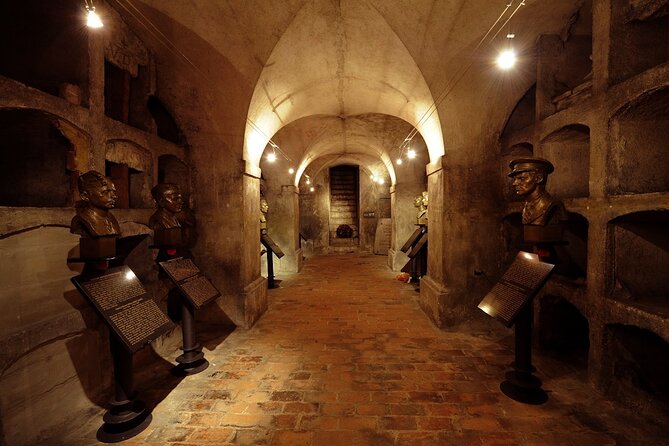
Prague has no shortage of grand buildings and pretty streets, but this tour asks you to look at the city through the people who lived under Nazi occupation and resisted it. Operation Anthropoid provides the central thread.
You begin with the wider setting. At the Powder Tower, the guide explains the establishment of Czechoslovakia and the political background that shaped the country before World War II. This opening matters because the tour is not only about one military operation. It sets out how the country came into being, what happened before the occupation, and why resistance carried such weight for Czech society.
From there, the route moves through places tied to the Czech national resistance. You hear about a secret resistance flat, see memorials connected with the Prague uprising, and walk by the former NSDAP headquarters. The Jewish quarter is also part of the route, adding another layer to the story of Prague under Nazi rule.
I would not choose this experience if you only want a quick introduction to World War II. The guide may cover Adolf Hitler, Germany, Czechoslovakia, the resistance, and the events before and after Operation Anthropoid in considerable detail. That is useful if you already have some interest in the subject, but it can feel heavy if you prefer a short sightseeing walk.
A few more Prague half-days to weigh up
- Prague: 50-Minute Sightseeing Evening Cruise
★ 4.2 · 33,780 reviews - Prague: Medieval Dinner with Unlimited Drinks
★ 4.4 · 19,847 reviews - Prague: Skip-the-line Castle Ticket and Optional AudioGuide
★ 4.3 · 11,121 reviews
Meeting at the Powder Tower
The tour starts in front of the Powder Tower in central Prague. It is a convenient place to begin, but it can be noisy and crowded. One practical point is worth taking seriously: stay close to the guide at the opening talk and make sure you can hear.
Several people found the starting explanation difficult to follow because of street noise, especially when the guide walked while speaking. If you are in a larger part of the group, move toward the front and do not hesitate to ask the guide to repeat a point.
The group size is capped at 20, which is small enough for questions but not necessarily intimate. The best departures appear to be those led by guides who actively keep the group together and project their voices. Hanna and Hannah received especially warm praise for vivid storytelling and local knowledge. Pavel, Pavlo, Paul, and George were also noted for clear explanations and strong command of the subject.
English ability can vary by guide. Most people should manage well, but a slight language barrier was a concern for some participants. This is one reason I would treat the guide as a major part of the booking decision, even though a specific guide may not always be guaranteed.
Resistance sites, archive images, and Prague’s wartime streets
The early walking section takes you beyond the usual postcard view of Prague. At the Czech national resistance secret flat, the guide explains how underground networks depended on hidden rooms, coded communication, and people willing to take serious risks.
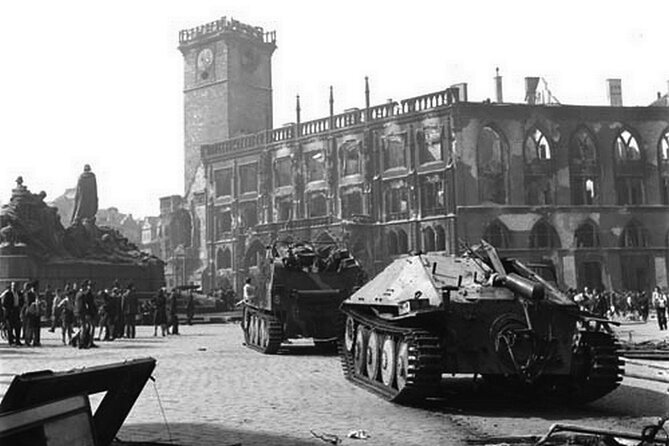
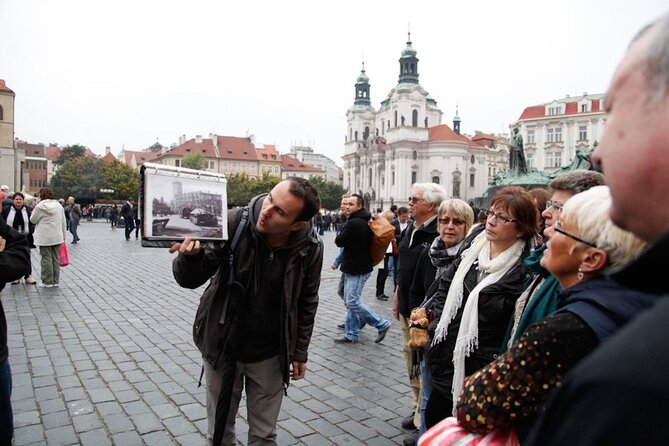
The route also uses archive photographs to show Prague before and during wartime events. You may see images of a hall and clock in ruins, then compare them with the present-day streets. This is a useful technique because it lets you read the city as a changing place rather than a fixed collection of old buildings.
Memorials connected with the Prague uprising help bring the final phase of the war into view. Walking from one site to another gives the guide time to link the locations, though it also means the experience is not a simple point-to-point visit. You are often listening while moving, so hearing the explanation depends on staying near the guide.
Passing the former NSDAP headquarters is brief, but it helps show how Nazi power occupied ordinary city spaces. The Jewish quarter adds further context. The tour does not treat wartime Prague as an isolated military story, and that wider frame is one of its strengths.
The medieval shelter at Dům pánů z Kunštátu a Poděbrad
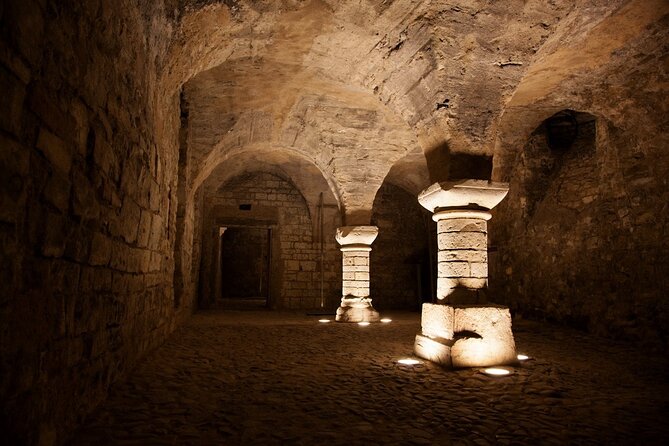
One of the most unusual stops is the medieval underground at Dům pánů z Kunštátu a Poděbrad. The space was used as an air-raid shelter during the bombing of Prague in 1944.
The setting gives the tour a physical change of mood. Instead of standing on a busy street while looking at a plaque, you go underground into a place used by civilians during air raids. The stop lasts about 20 minutes, and admission is included.
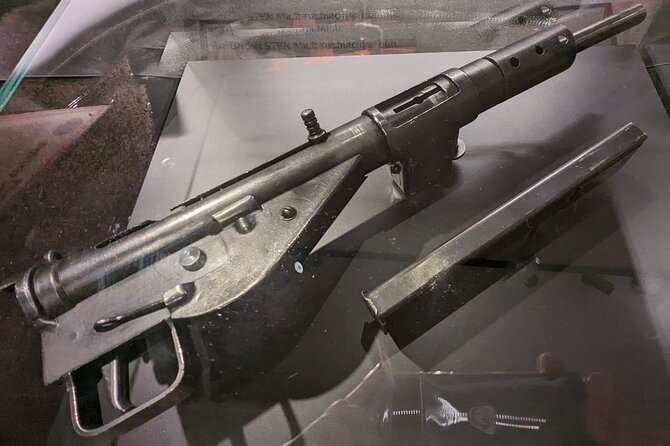
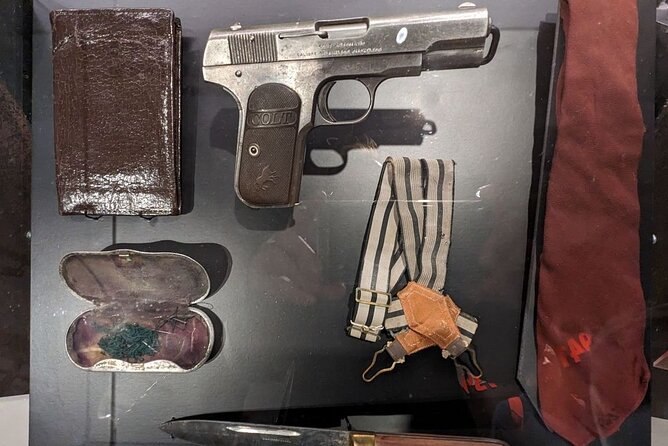
A private collection of WWII artifacts is displayed here. The objects give the guide something concrete to discuss, and several participants particularly liked being able to examine memorabilia at close range. Photos and artifacts also help break up the spoken presentation, especially during a tour that covers a lot of material.
This is where the tour can feel less like a standard sightseeing outing. You are not simply told that Prague endured bombing. You are shown a shelter connected with that experience, then given visual material to help place it in context.
One caution: at least one departure included a long pub stop, close to 45 minutes, where the guide showed photographs and documents. That may be useful for people who enjoy a slower presentation, but it can feel like lost sightseeing time if you expected a continuous walking route. Ask at the start how the schedule will run, particularly if you have plans afterward.
A different way to spend an afternoon here:
- Prague: Castle Tour with Local Guide and Entry Ticket
★ 4.6 · 10,422 reviews - Prague Castle 2.5-Hour Tour Including Admission Ticket
★ 4.7 · 8,927 reviews - Prague: Oldtown, Medieval Underground & Dungeon History Tour
★ 4.2 · 8,244 reviews - Prague: Vltava River Night Cruise with Buffet
★ 4.3 · 7,338 reviews
Saints Cyril and Methodius Cathedral
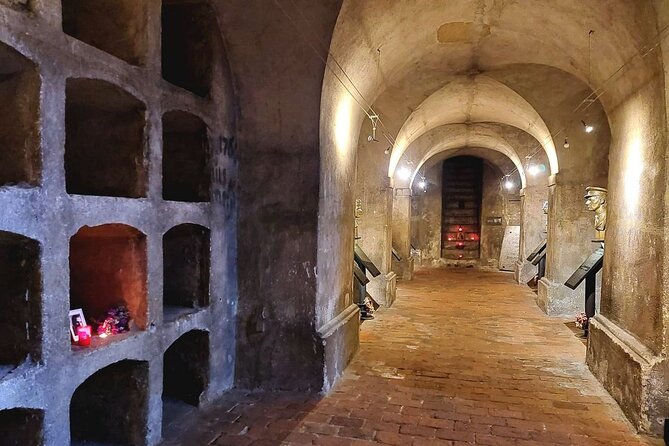
The tour then reaches Saints Cyril and Methodius Cathedral on Resslova Street. This is the final area of the experience and the place most closely associated with Operation Anthropoid.
The cathedral visit itself is short, listed at about 10 minutes, with no separate admission charge. The guide explains why the church matters before taking you below it. The transition from the open city to the interior of the cathedral gives the story a sharper focus.
You should expect a respectful and serious atmosphere here. This is not a theatrical attraction, and the experience works best when you allow the place to speak for itself. The guide may continue the story with photographs, maps, and artifacts, but the tone usually becomes quieter as the group approaches the crypt.
The tour ends at the National Memorial to the Heroes of the Heydrich Terror. This location is also the endpoint, at Resslova 9, so you are not returned to the Powder Tower. That is helpful if you want to continue exploring Prague’s New Town afterward.
Inside the crypt and the final battle
The National Memorial includes the crypt and the Operation Anthropoid museum below the cathedral. The visit lasts about 20 minutes, and admission is free.
This is the part I would plan the tour around. The crypt is confined, dim, and emotionally difficult. It preserves the place where the Czechoslovak parachutists fought their last battle, and the physical evidence described by the guide can be stark. Bullet holes in the walls and the narrow escape passage give you a sense of how limited the defenders’ options became.
The space is not large, so the group may need to move in stages. Listen carefully, leave room for others, and do not expect to spend a long time wandering independently. The guide’s explanation provides the structure, while the crypt itself supplies the atmosphere.
You can choose not to enter if the subject or setting feels too distressing. That is a sensible option, not a failure to complete the tour. The crypt is moving precisely because it deals with sacrifice, violence, and the end of a desperate resistance effort.
If you have seen a film or read about Operation Anthropoid, this visit will likely add a strong sense of place. If you know little about it, the guide’s earlier explanations are important. The crypt is far more meaningful when you understand who was there, what they were trying to do, and why the final confrontation took place.
Walking, trams, stairs, and the real timing
The tour lasts about two to three hours on paper, but I would budget three and a half hours if your schedule is tight. One group left after three and a half hours, and the route includes a good amount of walking, stairs, and public transport.
Included tram tickets are a useful touch. Prague’s public transport makes it easy to connect parts of the city, and using it avoids turning the tour into a long pavement march. Still, check that everyone in your party receives a ticket. One group discovered that a member had not been given one and had to arrange a separate ride back.
There may not be a bathroom break until late in the tour. If you are sensitive to long stretches without facilities, use one before meeting the group and ask about the planned pause.
Comfortable shoes are essential. The walk is manageable for most people, and the tour information says most participants can take part, but the combination of distance, stairs, and a serious amount of listening can be tiring. Service animals are allowed, and the route is near public transportation.
The tour is offered in English and generally runs with small groups. It is best suited to someone who enjoys walking while listening, rather than someone looking for a relaxed café-to-café outing.
Is the $43.53 price good value?
At $43.53 per person, the price is reasonable for a two to three hour guided tour that includes public transport and admission to the underground shelter. The crypt and cathedral portion does not require a separate admission fee, but the value comes from the guide’s interpretation and the way the sites are linked.
I would not judge this tour by the number of major monuments you see. Much of its value lies in places you could easily pass without understanding, such as the resistance flat, uprising memorials, former Nazi headquarters, and the shelter. The guide’s photos and artifacts add material you would not get from simply following a map.
The price feels strongest when you receive a guide who speaks clearly, answers questions, and keeps the group together. Hanna, Hannah, Pavel, and George were repeatedly praised for passion, detail, and an ability to make the subject accessible. On weaker departures, people struggled to hear or felt that the guide provided too many facts without enough explanation.
The high overall score and 95 percent recommendation suggest that most bookings deliver a worthwhile experience, but the uneven comments point to a practical truth: this is a guide-led tour, so the human element matters greatly.
Who should book this tour?
I would book it if you have a real interest in World War II, Czech resistance, occupation history, or Operation Anthropoid. It is also a good choice if you want to understand Prague beyond its churches, bridges, and handsome squares.
You will get the most from it if you already know the basic outline of World War II. The tour does provide background, but it may move beyond the simplest introduction. People who enjoy dates, political context, photographs, and detailed explanations should feel at home.
I would think twice if you have limited time, dislike long guided talks, or need a firm finish time. The tour can run well past three hours, and the subject is emotionally tough. If your group includes children, consider their comfort with wartime violence and a confined crypt before booking.
The final memorial is the reason to choose this experience over a general Prague walking tour. It brings you to a place where the story ended, while the earlier stops explain how the city and its people reached that moment.
FAQ
Where does the WWII in Prague Tour begin?
It begins in front of the Powder Tower at Powder Gate, 110 00 Prague 1, Czechia.
Where does the tour finish?
It finishes at the National Memorial to the Heroes of the Heydrich Terror, Resslova 9, Prague 2, near Saints Cyril and Methodius Cathedral.
How long does the tour take?
It is advertised as approximately two to three hours, though some departures have lasted about three and a half hours.
Is public transportation included?
Yes. Public transport tickets are included, and the route combines walking with tram travel.
What is the main Operation Anthropoid site?
The tour visits the crypt and museum beneath Saints Cyril and Methodius Cathedral, where the parachutists made their final stand.
Is admission to the crypt included?
Yes. Admission to the cathedral and the National Memorial to the Heroes of the Heydrich Terror is listed as free.
How many people can join the tour?
The maximum group size is 20 people.
Can I cancel for a full refund?
Yes, if you cancel at least 24 hours before the experience start time. Cancellations made less than 24 hours in advance are not refunded, and changes within that period are not accepted.
Should you book it?
Book this tour if you want a serious, detailed look at Prague’s WWII past and especially if the crypt of Operation Anthropoid is your main goal. The combination of resistance sites, archive images, a wartime shelter, public transport, and the final memorial gives you far more context than a quick visit to the cathedral alone.
Go prepared for a long walk, a possible three-and-a-half-hour schedule, and a guide whose delivery may shape the day. Arrive early, stay close enough to hear, confirm your tram ticket, and wear comfortable shoes. For history-minded visitors, the crypt makes this a meaningful use of a morning or afternoon in Prague.
Recently added around Prague
- St Vitus Cathedral and Prague Castle Private Walking Tour★ 4.0 · 3 reviews
- Prague: Old Town and Jewish Quarter Small-Group Tour★ 5.0 · 3 reviews
- Royal Splendor Unveiled Private Prague Castle Interior Tour★ 3.5 · 3 reviews
- Prague Castle Interiors & Changing of the Guard-Small group★ 5.0 · 3 reviews
- Running Tour of Prague. Your private 6-9K intro★ 5.0 · 3 reviews
- Prague: Bohemian & Saxon Switzerland National Park Day Trip★ 5.0 · 3 reviews
- PRAGUE AIRSOFT SHOOTING GAMES★ 4.7 · 3 reviews
- Private walking tour and Boat cruise Best of Prague★ 5.0 · 3 reviews
Prague Tours, compared.
Skip-the-line Castle Ticket and Optional AudioGuide
Read our review →
Castle Tour with Local Guide and Entry Ticket
Read our review →
Prague Castle 2.5-Hour Tour Including Admission Ticket
Read our review →
Oldtown, Medieval Underground & Dungeon History Tour
Read our review →