Reviewed · PRAGUE TOURS
Prague: Private Prague Art Nouveau and Cubism Tour
Prague’s most famous sights belong to older centuries, but this private walk shows you the city’s bold early 20th century side. You’ll follow Art Nouveau’s flowing lines from Central Station through New Town, then see how Czech Cubism pushed architecture in a sharper, more daring direction.
I like the strong cultural story, which explains why these styles appeared and why World War I brought their short golden age to an end. I also like the route’s final move beyond the center to the Cubist houses below Vyšehrad, an area you could easily miss on your own.
The main drawback is length. The route covers a lot of ground and takes about three and a half hours, including tram rides. If you prefer a compact walk, the final section may feel like a stretch, and comfortable shoes are essential.
Key points at a glance
- Central Station begins the story: Start inside Prague’s recently reconstructed 1909 railway station, a fitting example of the city’s Belle Epoque confidence.
- Art Nouveau and Cubism are explained together: You learn how Cubism grew partly as a reaction against the softer, more decorative style of Art Nouveau.
- Small details matter: The guide points out architectural features you might pass without noticing, including buildings away from the main sightseeing trail.
- The route includes major landmarks: See the Jubilee Synagogue, Municipal House, House of the Black Madonna, and Wenceslas Square.
- Vyšehrad adds the surprise: Public transport carries you to a quieter area with some of Prague’s most unusual Cubist buildings.
- Private guiding makes questions easy: Guides Max and Eva have led the experience in English or German, with clear answers about art, architecture, and history.
Why modern Prague makes a good walking subject
This is not a tour of Prague Castle, Charles Bridge, or the Old Town’s medieval churches. It focuses on a later chapter, when Prague was part of the Austro-Hungarian world and local architects were testing new ways to design public buildings, homes, shops, and religious spaces.
That makes the experience especially useful if you have already covered the standard sights. You’ll still see central Prague, but you’ll look at it through a different lens. Instead of treating each building as a pretty backdrop, you learn how style reflects politics, technology, taste, and changing ideas about national identity.
The period is close enough to modern life that you can follow the story without much effort. At the same time, it belongs to a world before World War I, when new architecture suggested confidence in the future. The guide connects that optimism with the shock of war and explains why both Art Nouveau and Cubism had such brief lives.
I appreciate that the tour also links modern architecture with Prague’s older buildings. The new styles did not simply replace the medieval and Baroque city. In many cases, modern architects helped preserve Prague’s older character by building around it and adding another layer to the city.
A few more Prague half-days to weigh up
- Prague: 50-Minute Sightseeing Evening Cruise
★ 4.2 · 33,780 reviews - Prague: Medieval Dinner with Unlimited Drinks
★ 4.4 · 19,847 reviews - Prague: Skip-the-line Castle Ticket and Optional AudioGuide
★ 4.3 · 11,121 reviews
Meeting at Central Station, where the Belle Epoque begins
The meeting point is in the middle of Platform 1 at Prague’s Central Train Station. Look for the guide carrying a red folder, with the exact meeting location described as near the UniCredit Bank cash machine.
The station itself is the first major stop. The building dates from 1909 and has recently been reconstructed, so you begin with a working transport hub that also carries the visual confidence of the Belle Epoque. This is a smart starting point: the station represents movement, new technology, and a city looking toward the 20th century.
You spend about 15 minutes here. That is enough time for the guide to set up the basic terms and explain what to look for as the walk continues. You will hear how Art Nouveau developed from 19th century styles and why its rejection of strict historic copying was such a major change.
Allow extra time to find Platform 1 if you are unfamiliar with the station. Arriving early will make the beginning calmer, especially if you have luggage or are making your way from another part of Prague.
From the Jubilee Synagogue to New Town details
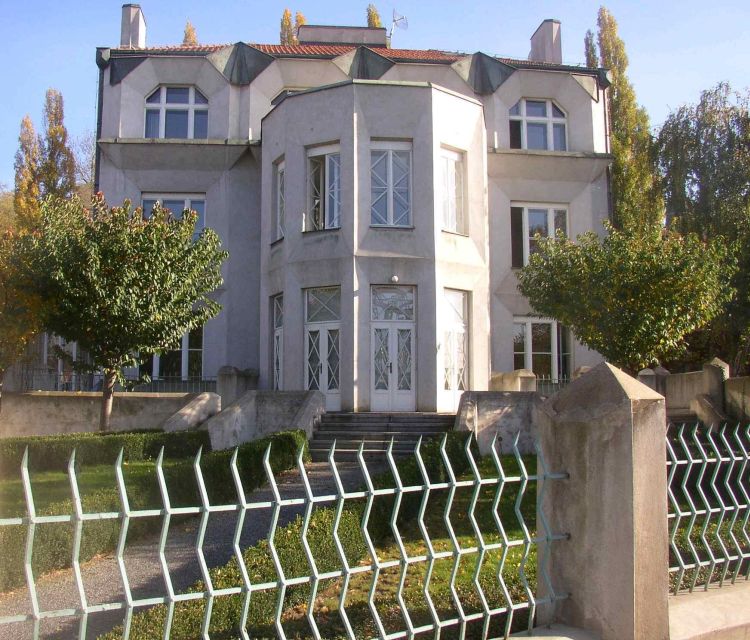
The first walking section is short. You move through New Town to the Jubilee Synagogue, where the stop lasts about five minutes. The building gives the tour an important cultural dimension, since Prague’s modern architecture was shaped by more than one community and more than one tradition.
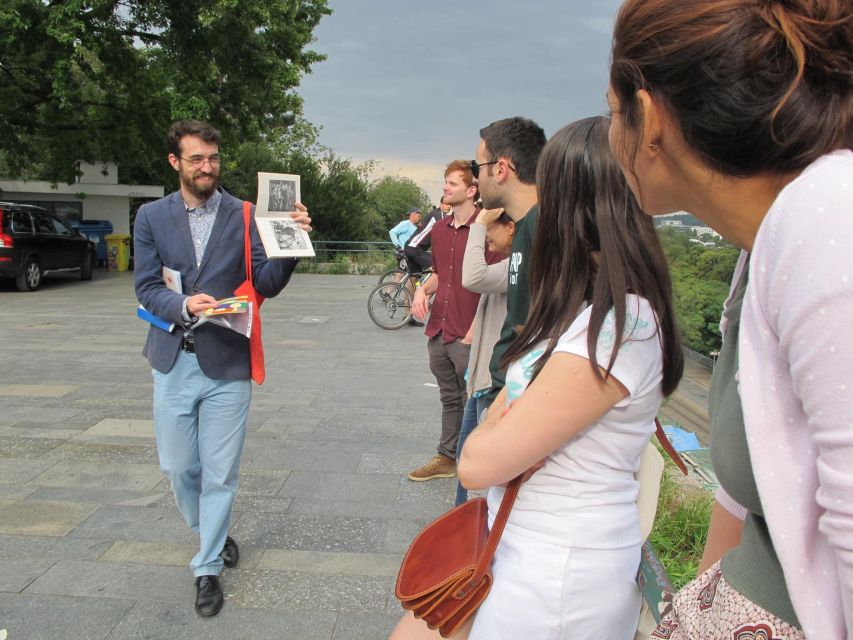
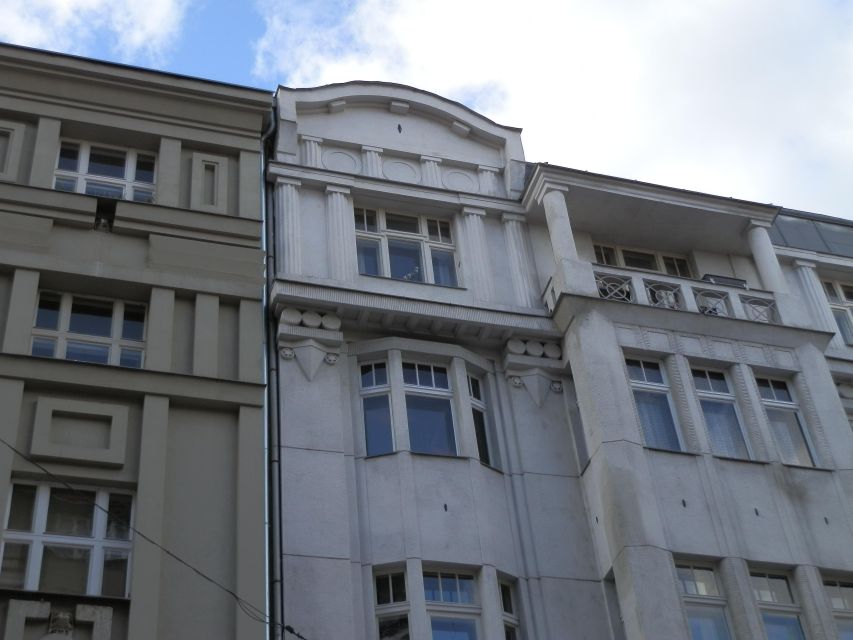
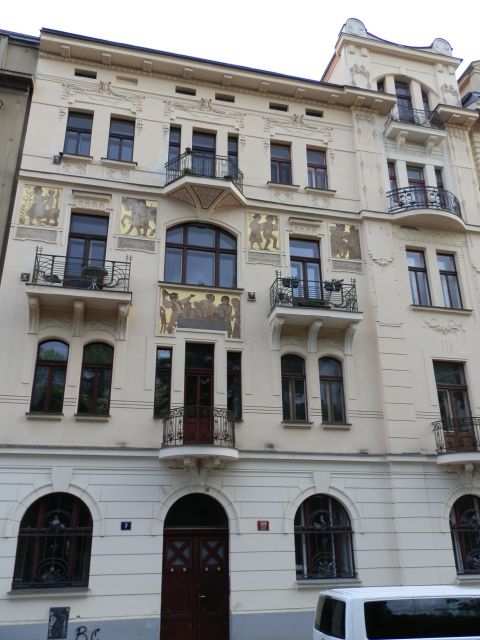
From there, the route turns toward several lesser-known buildings. Each stop is brief, usually around five minutes, and the value comes from the explanation rather than from entering every site. Your guide helps you notice facades, shapes, ornament, and the way a building fits into its street.
This part rewards people who like close looking. You might have walked past these addresses without giving them a second glance. With a guide, an unusual doorway, decorative detail, or change in geometry becomes evidence of a larger design movement.
The short stops also keep the route moving, but they can feel quick if you want time for photographs. If you enjoy architectural pictures, listen first and take your shots after the guide finishes the main explanation.
Municipal House and the polished face of Art Nouveau
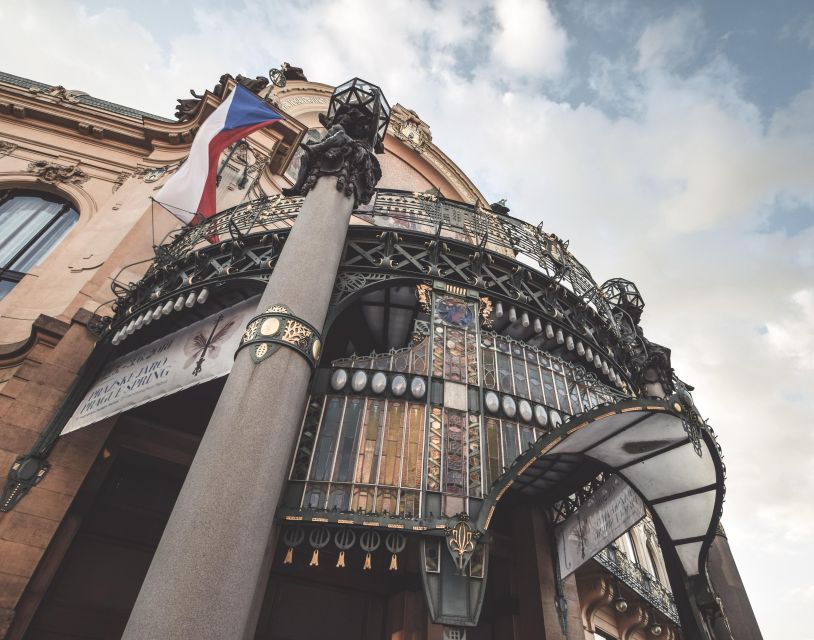
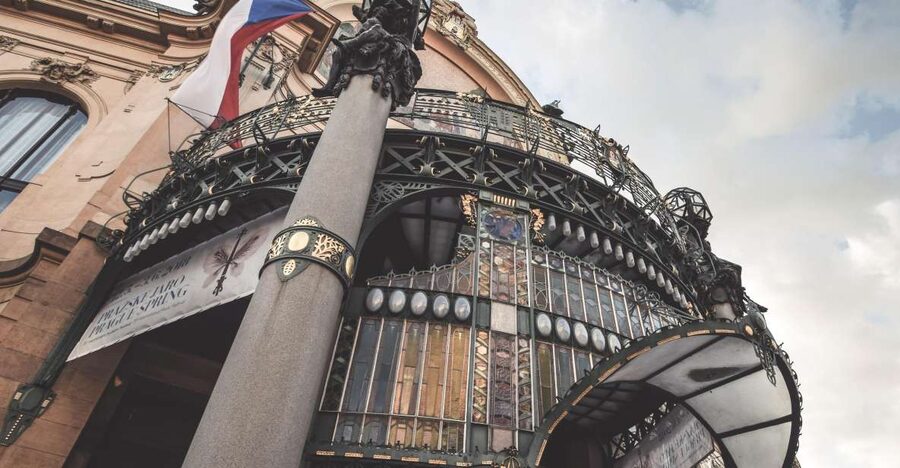
The Municipal House receives about 10 minutes, giving you more time with one of Prague’s key Art Nouveau landmarks. Its decorative treatment shows the style at its most public and confident, with the building presenting itself as a complete work of art rather than a plain structure with decoration added later.
The guide’s role here is to explain what separates Art Nouveau from earlier 19th century approaches. You can expect discussion of the style’s organic curves, ornamental focus, and interest in modern design rather than simple imitation of past periods.
This stop works well after the smaller buildings because you can compare scale and ambition. The route shows that Art Nouveau was not just a look used on grand civic buildings. Its ideas appeared in many parts of the city, from public architecture to private structures.
The stop is still fairly short. You will see and discuss the exterior, but this is not a full interior visit program. If the Municipal House is a priority for you, you may want to return separately for more time inside.
A different way to spend an afternoon here:
- Prague: Castle Tour with Local Guide and Entry Ticket
★ 4.6 · 10,422 reviews - Prague Castle 2.5-Hour Tour Including Admission Ticket
★ 4.7 · 8,927 reviews - Prague: Oldtown, Medieval Underground & Dungeon History Tour
★ 4.2 · 8,244 reviews - Prague: Vltava River Night Cruise with Buffet
★ 4.3 · 7,338 reviews
House of the Black Madonna and the turn toward Cubism
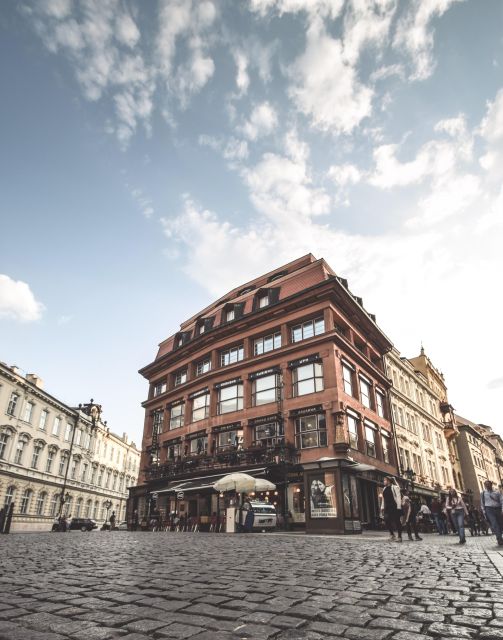
Next comes the House of the Black Madonna, another 10 minute stop and one of the most important moments of the walk. This building helps explain how Czech architects began to move away from the graceful curves and decorative language associated with Art Nouveau.
Cubism is often linked with painting, but Prague gives the movement a rare architectural presence. Here, the guide explains how Cubism favored sharper forms, unusual angles, and a more forceful visual rhythm. The style can seem strange beside Prague’s older buildings, which is exactly why it makes such an effective teaching point.
You’ll learn that Cubism developed partly as a revolt against the popular Art Nouveau style. That contrast is one of the tour’s strongest ideas. Art Nouveau sought flowing unity, while Cubism broke forms into harder, more complex shapes.
The building also helps you understand the local character of Czech modernism. This is not simply a story imported from elsewhere. Prague’s architects adapted new ideas to their own city, their own streets, and their connection to older Czech traditions.
Wenceslas Square and the city’s public face
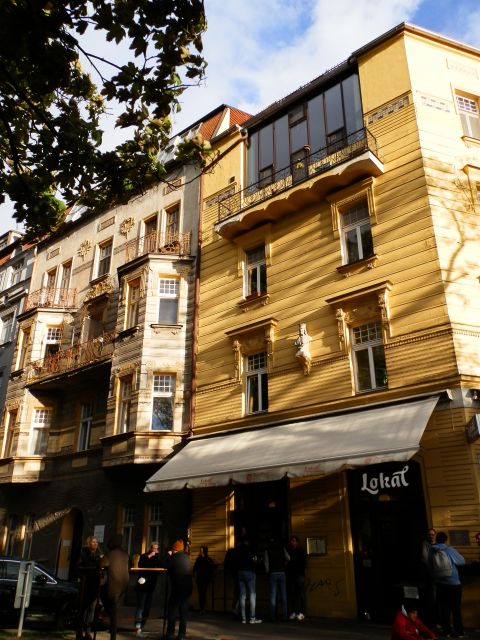
The route continues through more architectural stops before reaching Wenceslas Square, where you spend about 20 minutes. This is the longest sightseeing stop in central Prague and gives the guide space to connect individual buildings with the wider story of the city.
Wenceslas Square is a useful place to discuss how architecture works at a civic scale. Buildings here help form the public image of Prague, and the square has long been tied to important moments in the city’s modern history.
You will not simply be shown a famous square and sent on your way. The guide uses the surrounding buildings to explain shifts in taste and the tension between historic styles and modern design. That context is what turns the route from a facade-spotting walk into a lesson in how Prague changed.
The central section includes several five minute stops and short walks of three to five minutes. The pace is steady, but you should expect to be on your feet for most of the experience. There is no promise of a long café break, so plan accordingly.
The tram ride to Prague’s more daring Cubism
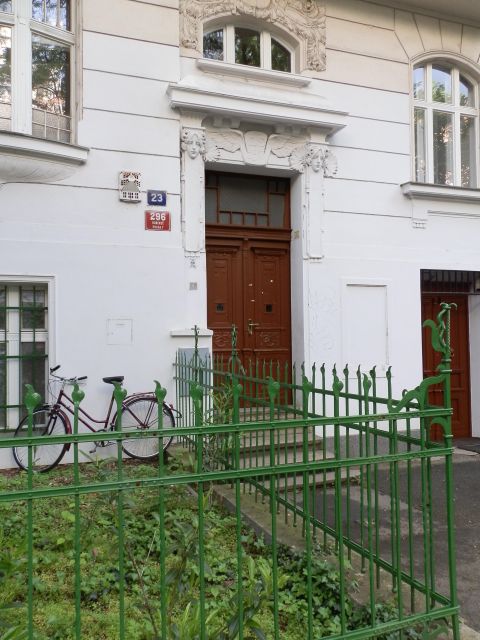
After the downtown portion, you take public transportation toward the area below Vyšehrad. The tram rides are short, around five minutes each, and the tickets are included in the price.
This change of setting is one of the best features of the tour. The first part shows you Art Nouveau and Cubism within central Prague’s busy architectural mix. The later section takes you away from the main sightseeing zone to see buildings that are harder to find without local direction.
The transport connection also makes the route practical. You do not need to arrange your own tickets or work out the correct tram journey during the tour. At the end, a nearby tram stop gives you a straightforward way back toward downtown, with the return ticket included as well.
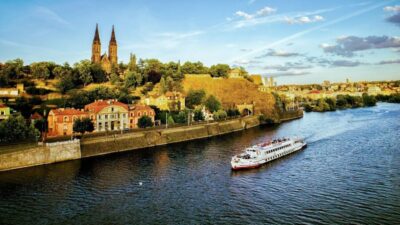
The route is not entirely a walk, but do not mistake the tram rides for a break from the program. You continue with short walks and outdoor stops after arriving near Vyšehrad.
Three Cubist Houses and the final architectural lesson
The Three Cubist Houses receive a five minute stop. Their name tells you what to expect: a group of buildings where geometric forms and faceted surfaces become the main visual language.
This is where the earlier explanation of Cubism starts to make practical sense. Instead of seeing the movement only as a theory or as one central building, you can compare several structures in the same area and see how architects applied the ideas to residential design.
The stop is brief, but the surrounding area gives the tour a different mood from the central streets. You get a better sense of how experimental design could appear in an ordinary neighborhood rather than only in a major civic building.
From there, the route continues on foot to Kovařovicova vila, a five minute stop. The villa adds another type of building to the discussion and shows how Cubist thinking could shape a private home, not just commercial or public architecture.
The final stop is Cubist house Vyšehrad number 98. It is another five minute look at the movement’s local expression. By this stage, you have enough examples to compare the decorative curves of Art Nouveau with Cubism’s hard-edged forms.
This final section is also where the duration becomes a personal choice. One assessment of the tour found the last part too long and suggested that two and a half to three hours would be enough. I can understand that view. If you are passionate about architecture, the extra stops are the point. If you mainly want an introduction, the central portion may already satisfy you.
What the private format changes
This is a private group experience, so you are not sharing the guide with a large crowd. That matters on an architecture walk because questions often shape the experience. You can ask why a detail matters, compare two buildings, or request a clearer explanation without trying to speak over other people.
Max has guided the experience in both English and German, and Eva has also led it in a clear, well-informed way. Max’s German received particular praise for its ease and warmth, while his explanations in English have been described as clear and compelling. Eva’s strength is her ability to cover many different styles while keeping the experience educational.
The guide is the main value here. You are not paying simply for access to buildings, since most of the route is an outdoor walk. You are paying for a trained eye, a route through places you might not locate alone, and the cultural framework that makes the architecture easier to read.
Is $84 a fair price?
At $84 per person, this is not the cheapest way to spend a few hours in Prague. It is a private tour, though, and the price includes public transportation tickets for the outward and return journeys. If you are traveling with a small group, the cost may feel more reasonable because you are sharing a private guide rather than buying several separate services.
The value depends on your interests. If you want Prague’s headline sights, you can see many of them more cheaply on your own. If you care about design, urban history, or finding parts of the city outside the usual route, the fee buys something harder to reproduce with a guidebook.
The experience also makes better sense for people who have several days in Prague. You do not need to choose between this and the city’s main sights. You can spend one day on the castle and Old Town, then use this tour to understand the city’s modern side.
Free cancellation up to 24 hours before the start and reserve now, pay later terms make planning less rigid. The tour is offered in English and German, and it is wheelchair accessible. Children under 12 are not permitted.
Who should book this Prague Art Nouveau tour?
I would recommend it most strongly if you:
- Have already seen Prague’s main medieval and Baroque sights
- Enjoy architecture, design, or urban history
- Want a private guide who can answer detailed questions
- Have enough time for a three to three and a half hour program
- Are happy to spend most of the experience walking outdoors
- Want to see modern buildings away from the central sightseeing route
You may want to skip it if you dislike long walks, prefer a short overview, or have only a few hours in Prague and want to focus on the city’s famous landmarks. The tour does not replace a general city introduction. It works as a specialist experience with a broad historical story.
Wear comfortable shoes. The route includes several walks, repeated stops, and a final area reached by tram. The included transport is useful, but you will still need to manage a full stretch of walking.
Should you book it?
Book this private Prague Art Nouveau and Cubism tour if you want to understand the city through its buildings rather than simply photograph them. The best parts are the clear explanation of how Art Nouveau and Cubism relate to one another, the chance to see buildings outside the usual center, and the personal attention of guides such as Max and Eva.
The only serious question is length. If three and a half hours sounds tiring, ask yourself how much you want the Vyšehrad section. For architecture fans, that final stretch is likely the payoff. For everyone else, the central route may be enough, but the tour is designed to include both.
FAQ
Where does the tour start?
It starts at Prague Central Train Station, in the middle of Platform 1. The guide carries a red folder, and the meeting point is near the UniCredit Bank cash machine.
How long does the tour last?
The activity is valid for one day, while the walking program takes roughly three and a half hours, including short tram rides and walks between stops.
Which languages are available?
The live guide is available in English and German.
Is the tour private?
Yes. It is offered as a private group experience.
What public transportation is included?
Tickets for the public transportation used during the tour are included. This covers the rides toward the Vyšehrad area and the return journey toward downtown.
Is the tour wheelchair accessible?
Yes, the activity is listed as wheelchair accessible.
Can children under 12 join?
No. The experience is not suitable for children under 12.
Recently added around Prague
- Prague Bike Rental★ 4.4 · 6 reviews
- Discover Prague Private Tour – 3 hours★ 5.0 · 6 reviews
- Prague: 120min Private Tour in Vintage Car, up to 6people!★ 4.0 · 6 reviews
- eBike rental – 3hrs★ 4.5 · 6 reviews
- Prague: Cocktail Making Workshop with Bartender★ 3.9 · 6 reviews
- Prague beer tour with brewery visit and tasting★ 4.2 · 6 reviews
- Private Day Trip from Prague to Cesky Krumlov★ 5.0 · 6 reviews
- Prague: 1-hour Cruise with Audio Guide★ 3.0 · 6 reviews
Prague Tours, compared.
Skip-the-line Castle Ticket and Optional AudioGuide
Read our review →
Castle Tour with Local Guide and Entry Ticket
Read our review →
Prague Castle 2.5-Hour Tour Including Admission Ticket
Read our review →
Oldtown, Medieval Underground & Dungeon History Tour
Read our review →