
Reviewed · COMMUNISM AND COLD WAR TOURS
Communism & Nuclear Bunker Tour + 70s Canteen Lunch (own expense)
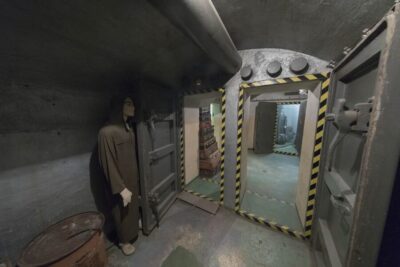
Prague’s most surprising Cold War experience happens below street level. After walking through Old Town and Wenceslas Square, you enter a real 1950s nuclear bunker, a stark shelter built for an age when nuclear war seemed possible. The bunker has Soviet-era objects, exhibits, and interactive details that make the past feel close rather than abstract.
I like two things especially. First, the tour connects major political events with ordinary life, from manipulated trials and shortages to school, work, and fear under the Communist regime. Second, the small group, capped at 10 people, gives guides such as Klara, Clara, and Leo time to answer questions and share personal family stories. The main drawback is that this is a history walk, not a classic sightseeing tour, and the narrow bunker is not a good fit for people with claustrophobia.
Key points to know before you book
- A real Cold War bunker finishes the walk: The shelter is in the upper part of Wenceslas Square and includes a one-hour visit.
- The route links Prague’s modern history: You walk from the Powder Tower through Old Town Square, Bartolomejska Street, Narodni Street, and Wenceslas Square.
- The 1970s canteen is part of the experience: Food and drinks cost extra, but the setting gives you a chance to try everyday Czech fare and Kofola.
- Small groups make the discussion personal: The maximum is 10 people, and tours sometimes run with only two, three, four, or six participants.
- The bunker entrance fee is included: The stated 10 EUR museum fee is covered in the tour price.
- Plan for walking and confined spaces: Most people can take part, but you need reasonable mobility for the route and stairs inside the shelter.
Why the bunker is the right place to end
A standard Prague walking tour can explain the Astronomical Clock, Gothic churches, and royal history. This experience takes a different path. It asks you to think about what happened after the Second World War, when Czechoslovakia moved from liberation to Communist rule and then, slowly and painfully, toward democracy.
The bunker gives that story a physical ending. You are no longer looking at a monument from a pavement. You are below the city, in a space designed for officials and civilians who might have needed protection from a nuclear attack. The atmosphere is plain and functional, which is part of its power.
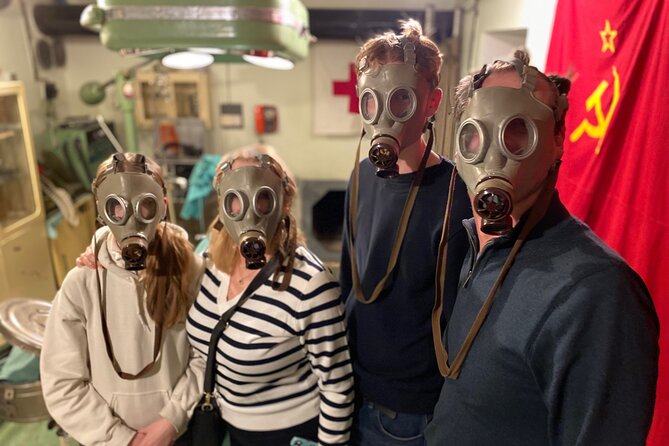
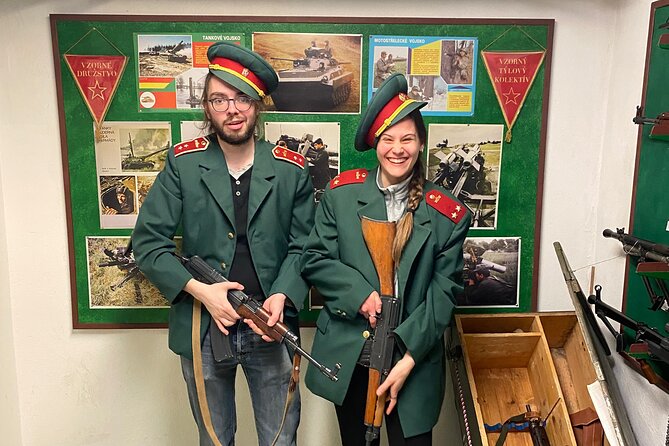
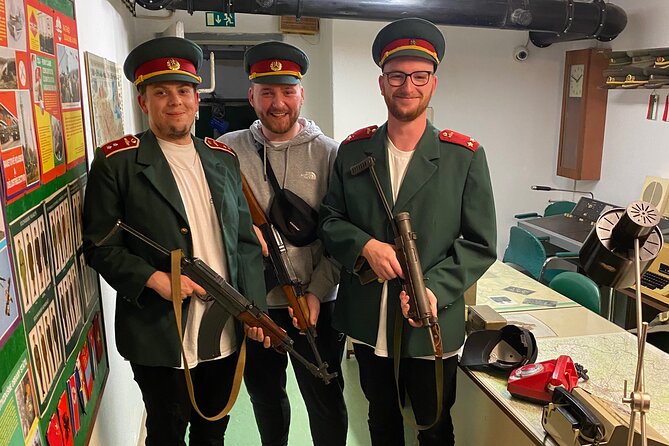
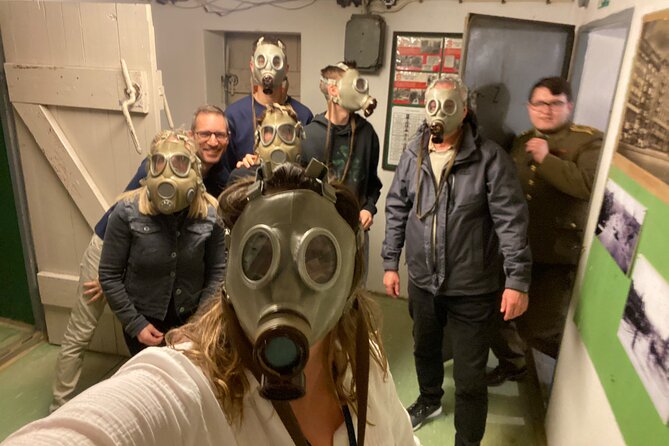
The bunker visit lasts about one hour. The experience can include authentic Soviet-era items, exhibits, a gas mask, and staged activities connected with military and secret-police life. Details vary by guide and group, but you might be invited to handle objects or take part in a mock interrogation. These touches give the visit some humor without removing the serious subject.
You should know what this is not. It is not a huge underground complex or a polished theme attraction. Its appeal comes from the preserved setting and the way your guide explains it. If you like modern European history, political change, or Cold War stories, the bunker is likely to be the strongest part of the tour.
More communism and Cold War walks:
- Prague: Communism History and Nuclear Bunker Guided Tour
★ 4.7 · 2,417 reviews - Prague Communism History and Nuclear Bunker Tour
★ 5.0 · 1,742 reviews - Prague: Communism and Bunker Tour with 70s Canteen Lunch
★ 4.8 · 250 reviews
Starting at the Powder Tower and Republic Square
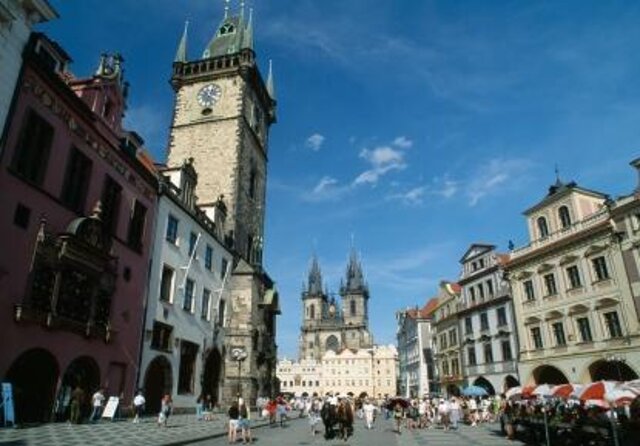
Meet your guide beneath or near the Powder Tower at Náměstí Republiky. Look for the guide with a blue umbrella. Republic Square is a useful starting point because it sits between Prague’s Old Town and New Town, and the Powder Tower itself introduces the city’s older royal past before the discussion turns to the 20th century.
The first stop lasts about 15 minutes. Your guide explains the creation of the Czechoslovak Republic in 1918, why Hitler focused on the country early in the Second World War, and how the war shaped the postwar political order.
This is important groundwork. The Communist takeover did not happen in isolation. The guide sets out why the Communist Party gained support in the 1946 election, then shows how wartime trauma, Soviet influence, and political uncertainty helped shape what came next.
You will not spend long at each point, so listen for the broad chain of events rather than expecting a full lecture on every year. The walk works best when you ask questions. Small groups make that easy, and guides have been praised for explaining difficult political material in a clear, conversational way.
Old Town Square and the era of fear
At Old Town Square, you stand where the Communist Party celebrated its victory in 1948. The square is one of Prague’s grandest spaces, filled with monumental buildings and familiar sightseeing views. Against that setting, the guide describes what the political victory meant for real people.
The discussion turns to the 1950s, often remembered as an era of fear. You learn about working camps, collectivization, secret police surveillance, and trials shaped by the state rather than by fair evidence. You also hear about life behind the Iron Curtain and the former location of Prague’s giant Stalin monument.
This stop is valuable because it moves beyond the simple idea that Communism meant one political party in power. You get a sense of how the system reached into employment, property, agriculture, speech, and daily choices. The guide may also use photographs to show how places looked at the time, which helps you connect the story to the streets around you.
Old Town Square can be crowded, and the guide’s voice may compete with city noise. Stay close to the group and expect to pause rather than sit. The setting is visually impressive, but the subject is grim, so this portion has a more serious tone than the canteen break that follows.
Wenceslas Square and the Prague Spring
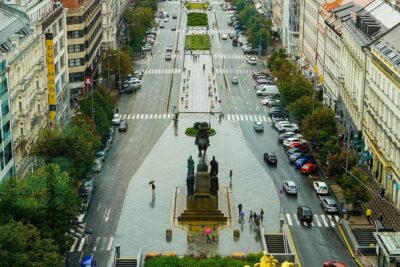
The tour then moves toward Wenceslas Square, one of the main stages of modern Czech history. In August 1968, this area became central to the Warsaw Pact occupation that crushed the Prague Spring, the reform movement that had raised hopes for a freer form of socialism.
Your guide explains the political changes of the 1960s and the Soviet claim that its intervention was peaceful assistance. That wording matters. The tour presents the occupation as a forceful end to the country’s attempt at reform, not as a friendly rescue.
The walking route also includes Narodni Street, where a student demonstration was violently broken up by state police on November 17, 1989. That event helped trigger the Velvet Revolution. From there, the story moves toward Václav Havel and the people who helped bring the Communist regime to an end.
This section takes about 30 minutes. It can be the most rewarding part for anyone who wants to understand how the fall of Communism looked from the street. Wenceslas Square is not just a broad avenue lined with shops. It is a place where people gathered, protested, watched tanks arrive, and eventually helped force political change.
You also pass Kotva shopping mall and the former secret-police headquarters on Bartolomejska Street. These are not grand attractions with long museum visits. Their value comes from the explanation. A good guide turns an ordinary facade, side street, or shopping center into part of the larger story.
More lunch stops around Prague:
- Prague Guided Walking Tour and Cruise with Authentic Czech Lunch
★ 5.0 · 3,627 reviews - Prague: Vltava River Lunch Cruise in an Open-Top Glass Boat
★ 4.5 · 2,865 reviews - Prague: Hard Rock Cafe with Set Menu for Lunch or Dinner
★ 4.4 · 1,487 reviews - Full-Day Prague Tour with Prague Castle, Lunch and Vltava Cruise
★ 4.0 · 921 reviews
A 1970s worker’s canteen at your own cost
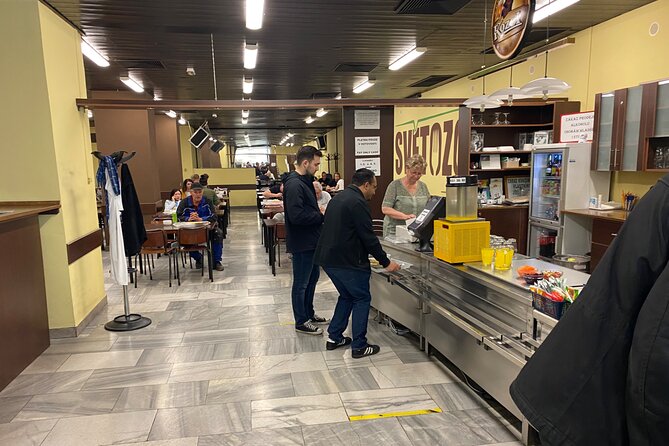
The lunch stop changes the pace. At a local worker’s canteen, your guide helps you choose food and drinks in a setting that recalls the 1970s. This is not included in the tour price, so bring money for whatever you order.
You can try Kofola, the popular Czech soft drink created during the Communist period, or order a beer. You might also choose a proper working-class meal. Previous meals have included pork with paprika and potatoes, and the canteen is known for reasonable prices and a senior discount.
I like this stop because it gives you an experience that a museum display cannot provide. You see the style of food service, sit with the group, and get help from a local guide who knows what to order. If you have never eaten in a Czech canteen, you probably would not find this place on your own.
The 30-minute break is short. You are not being offered a leisurely restaurant lunch with a long menu. Treat it as a practical taste of everyday food and social life. If you have dietary restrictions, the supplied information does not specify what alternatives are available, so ask your guide before ordering.
The meal also gives the group time to talk. Several guides, including Klara, have made this one of their favorite parts because everyone can sit together and discuss what you have seen. For solo visitors, it can be a relaxed way to meet the other people on the tour.
Inside the shelter beneath Wenceslas Square
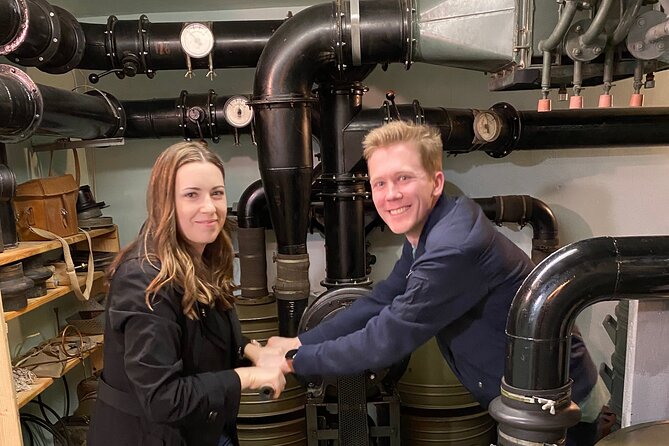
The tour ends in the upper part of Wenceslas Square, where you enter the Cold War museum and nuclear shelter. The 10 EUR entrance fee is included, a useful detail when comparing this experience with shorter walking tours that charge separately for the bunker.
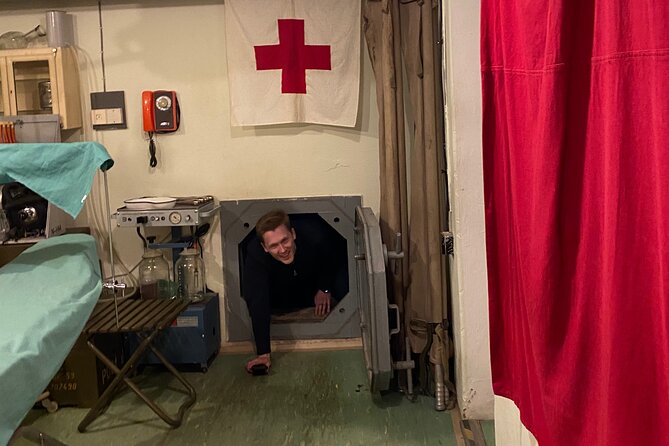
The shelter dates from the 1950s. You take an elevator down one level, then walk roughly 30 steps to a second level below. That means the visit is manageable for many people, but it is not completely step-free. The narrow rooms also make this a poor choice if confined spaces cause serious discomfort.
Inside, the exhibits show how the shelter was intended to function and what Cold War emergency planning looked like. Authentic Soviet-era artifacts give the rooms a used, practical feel. The bunker is not simply a dark corridor. It has displays and hands-on features that help explain the people, equipment, and fears connected with the period.
The mock secret-police interrogation and gas-mask activity can add a playful edge. That may not suit everyone, especially if you prefer a strictly formal museum. I found the balance useful: the activities help younger visitors and first-time history students stay involved, while the guide keeps the larger human cost in view.
Allow the full hour. Rushing through the shelter would lose much of the point. Guides such as Klara and Leo have been praised for making the serious material understandable while still keeping the visit lively. Their role matters here because the objects need context. Without explanation, a bunker can become a collection of old rooms. With the right guide, it becomes a window onto the anxieties of a whole period.
How the small group changes the experience
The maximum group size is 10, which is one of the tour’s clearest advantages. Some departures have had only two people, while others included three, four, or six. A small group means you can hear the guide more easily at busy squares and ask about topics that interest you.
The guides are a major part of the experience. Klara and Clara are described as warm, personal storytellers who sometimes share family experiences of life in Communist Czechoslovakia. Leo has also led tours, with a strong focus on explaining the country’s political journey and answering questions. Stan is another guide associated with the bunker visit.
Guide names and styles can vary by departure, so do not book expecting one specific person unless the booking system confirms it. The consistent benefit is the chance for conversation. You are not being moved from point to point with a memorized speech and no time for discussion.
The small-group format also helps solo visitors. You can talk with the guide and other participants during the walk and at the canteen. It is a social experience, but not one that forces you into a large crowd.
Price, timing, and practical value
The listed price is $35.07 per person for about three hours and 30 minutes. At that rate, you receive a guided walk through Old and New Town history, a small-group format, the canteen stop, and the 10 EUR bunker entrance fee.
The food and drinks are extra. That is fair, since you choose what to buy, but remember that the advertised price is not the complete cost of the afternoon. You should also allow for the walking involved between the Powder Tower and Wenceslas Square.
The value is strongest if you want context rather than a checklist of famous buildings. You will see well-known parts of central Prague, but the guide uses them to explain 1918, the Second World War, the 1948 Communist victory, the 1950s repression, the 1968 occupation, and the 1989 revolution.
If your only goal is to enter a bunker, a shorter bunker visit may suit you better. If you want a broad medieval tour, this is also not the right choice. But if modern Czech history is missing from your Prague plans, the combination of street-level history, local food, and an actual shelter gives you a lot for the time and price.
Confirmation is provided when you book, and free cancellation is available up to 24 hours before the start time. Meet at the Powder Tower, and note that the tour concludes in the upper part of Wenceslas Square rather than returning to the starting point.
Who should book this Prague history walk
I would choose this tour if you enjoy political history, Cold War Europe, museums with real artifacts, or local food without the polish of a formal restaurant. It also suits anyone who has already seen Prague’s main medieval sights and wants to understand the country’s recent past.
Families with older children and teenagers may appreciate the bunker’s interactive elements. The gas mask and mock interrogation can make the subject easier to grasp, although parents should remember that the discussion includes state violence, fear, imprisonment, and occupation.
You should think twice if you dislike walking, need a fully step-free route, or feel uneasy in narrow underground spaces. The route is suitable for most people, but the bunker includes about 30 steps after the elevator, and the tour does not focus on accessible sightseeing.
Should you book the Communism and Nuclear Bunker Tour?
Yes, if you want Prague explained through its 20th-century struggles rather than only its castles and church towers. The bunker and personal storytelling are the main reasons to book, while the canteen adds a welcome taste of ordinary life.
I would not choose it as your only Prague tour if you are visiting for the first time and still need a general introduction to the city. But as a focused half-day experience, it fills a real gap. Book it when you want clear history, a small group, a local meal, and one memorable hour beneath Wenceslas Square.
FAQ
Where does the Communism and Nuclear Bunker Tour start?
The tour starts at the Powder Tower, at Náměstí Republiky 5 in Prague’s Old Town.
Where does the tour finish?
It finishes in the upper part of Wenceslas Square, Václavské náměstí.
How long does the experience last?
The tour lasts approximately three hours and 30 minutes.
What language is the tour offered in?
The tour is offered in English.
How many people can join the group?
The maximum group size is 10 participants.
Is the nuclear bunker entrance included?
Yes. The 10 EUR Cold War Museum entrance fee is included in the tour price.
Is lunch included in the ticket price?
No. Food and drinks at the 1970s canteen are at your own expense.
What can I order at the canteen?
You can order Kofola, beer, or a working-class Czech meal. The available food depends on the canteen’s offering at the time.
Is the tour suitable for people with claustrophobia?
It is not recommended for people with claustrophobia because the final visit takes place in a nuclear bunker with narrow underground spaces.
Can I cancel for a full refund?
Yes. You can cancel at least 24 hours before the experience starts for a full refund. Changes or cancellations made less than 24 hours before the start time are not accepted.
Recently added around Prague
- St Vitus Cathedral and Prague Castle Private Walking Tour★ 4.0 · 3 reviews
- Prague: Old Town and Jewish Quarter Small-Group Tour★ 5.0 · 3 reviews
- Royal Splendor Unveiled Private Prague Castle Interior Tour★ 3.5 · 3 reviews
- Prague Castle Interiors & Changing of the Guard-Small group★ 5.0 · 3 reviews
- Prague: Bohemian & Saxon Switzerland National Park Day Trip★ 5.0 · 3 reviews
- Running Tour of Prague. Your private 6-9K intro★ 5.0 · 3 reviews
- PRAGUE AIRSOFT SHOOTING GAMES★ 4.7 · 3 reviews
- Private walking tour and Boat cruise Best of Prague★ 5.0 · 3 reviews
Communism and Cold War Tours, compared.
Communism History and Nuclear Bunker Guided Tour
Read our review →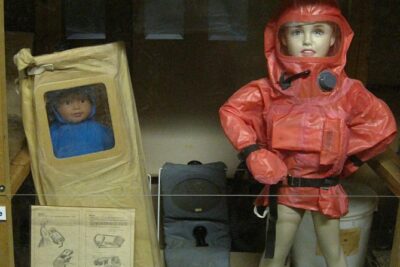
Prague Communism History and Nuclear Bunker Tour
Read our review →
Communism and Bunker Tour with 70s Canteen Lunch
Read our review →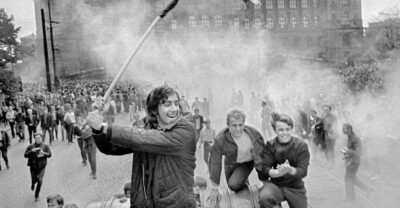
Second World War & Communism (Tip-based 3 hour tour)
Read our review →
Browse the lists this tour appears in